
Fasting Insulin: The Early Warning Sign Your Blood Sugar May Miss
Most people have had their blood sugar checked. Far fewer have had their fasting insulin checked — and that single number can reveal problems with your metabolism years before your blood sugar ever looks abnormal.
The short version
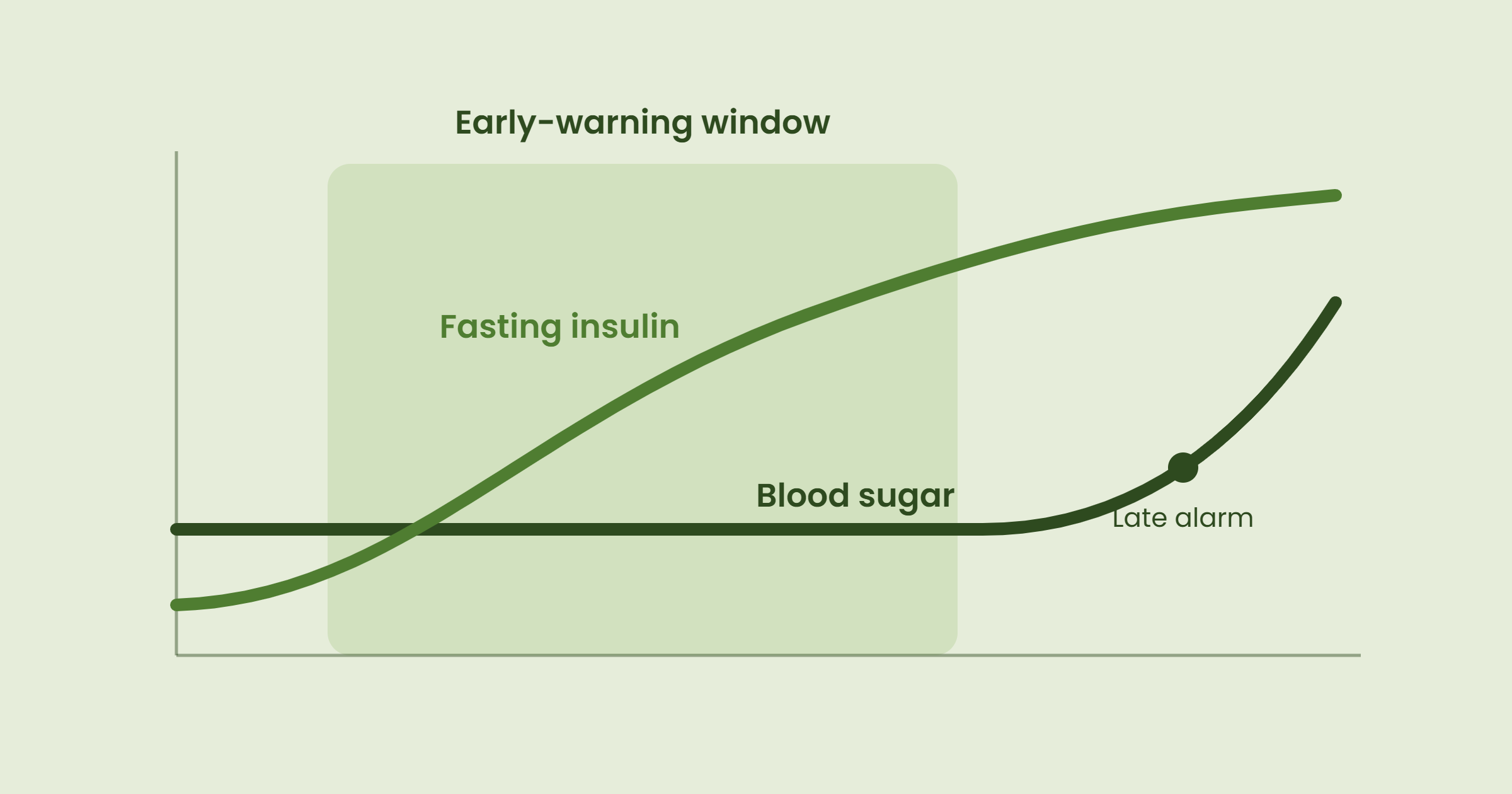
Your blood sugar can look completely normal while your body is quietly working overtime to keep it that way. Fasting insulin shows you how hard your body is working behind the scenes. It's an early-warning signal, whereas blood sugar and A1c are more like late alarms.
What insulin actually does
Insulin is the hormone that moves sugar out of your bloodstream and into your cells for energy. When your cells stop responding well to insulin — a condition called insulin resistance — your pancreas compensates by pumping out more and more of it. For a while, this extra insulin succeeds in keeping your blood sugar in the normal range.
That's the catch: your glucose looks fine, but only because your insulin is running high to force it there.
Why fasting glucose and A1c miss the early problem
- Fasting glucose is a snapshot of your blood sugar this morning.
- A1c is an average of your blood sugar over the past 2–3 months.
Both stay normal until your pancreas can no longer keep up. By the time glucose and A1c start to rise, insulin resistance has often been building for years — sometimes more than a decade. In other words, these common tests tend to catch the problem late, after a lot of the groundwork has already been laid.
Fasting insulin, by contrast, can rise early, while everything else still looks reassuring. It helps answer the question these other tests can't: "How hard is my body working to keep my sugar normal?"
Why this matters for your health
Insulin resistance isn't just about diabetes. It sits at the center of a cluster of conditions, including:
- Type 2 diabetes (which it can precede by many years)
- Fatty liver disease
- High triglycerides and low HDL ("good") cholesterol
- High blood pressure
- Increased risk of heart disease
Importantly, you don't have to be overweight to have insulin resistance. People at a normal weight — especially those carrying extra fat around the midsection — can have it too, which is one reason it so often goes undetected.
How it's measured
Fasting insulin is a simple blood test, drawn after you haven't eaten for several hours (usually overnight). There is no universally agreed-upon "perfect" cutoff, and labs vary, so your result is best interpreted by your clinician in the context of your whole health picture — not read in isolation.
The encouraging part
Insulin resistance is one of the most reversible problems in medicine. The same steps that improve it are ones you may already be working on:
- Regular physical activity, especially strength training and walking after meals
- Reducing refined carbohydrates and sugary drinks
- Losing excess fat around the midsection, even a modest amount
- Prioritizing sleep and managing stress
Catching insulin resistance early — while your blood sugar is still normal — gives you the widest possible window to act before it progresses.
The takeaway for you
A normal blood sugar or A1c is reassuring, but it doesn't rule out an underlying metabolic problem. If you have a family history of diabetes, fatty liver, stubborn weight around the middle, or abnormal cholesterol, ask your clinician whether checking a fasting insulin makes sense for you. It's a small test that can tell a much bigger story about your long-term health.
For more information on how to lower fasting insulin and improve your metabolic health, click here.
This handout is for general education and isn't a substitute for personalized medical advice. Talk with your clinician about which tests are right for you.